App Reviews
Otter vs Fireflies for Small Business Audio Files: Imports, Minutes and Storage
Count files as well as minutes. Compare ongoing free limits and account conditions before uploading an existing recording batch.
Published , 4 min read, by Copied Editorial team
If the recordings already exist, choose a transcription service by the files you need to import. Count their number, individual length and total minutes, then check the actual account’s remaining allowance and storage. Otter Basic’s monthly minutes do not replace its lifetime import limit. Fireflies’ live-meeting transcription offer does not establish unlimited uploaded-file access.
We reviewed official documentation on October 30, 2026 and use a fictional capacity example. We have not created accounts, uploaded recordings, tested transcripts or compared accuracy and processing speed. It concerns existing recordings you are authorized to use, not permission to record someone or invite a meeting bot.
Start with a file inventory
Write down the format, duration and size of each file, plus how long you need to retain the result. Separate the original recording from a generated transcript and from an approved summary. Before uploading, confirm that the material is appropriate for the service and your business’s requirements. Use a harmless sample for evaluation rather than a sensitive customer recording.
A few short files and one long recording can create different problems even when their total length is identical. Check the actual account before choosing an upgrade. Existing credits, previous imports and older-account terms can change which allowance is still available to you.
Otter: monthly minutes, individual length and lifetime imports
Otter’s current plan table lists Basic as Free, with 300 monthly transcription minutes, a 30-minute conversation limit and three lifetime audio or video file imports. These are separate constraints. A new monthly cycle does not turn three lifetime imports into three new imports every month.
Otter’s Basic limits guide explicitly calls the import allowance per account, not per month. It also explains that a longer recording can continue beyond 30 minutes while Basic access to its transcript remains limited to that duration. The guide lists the 25 most recent conversations in history, with older ones archived. Inspect ongoing access separately from the original file’s existence.
Fireflies: upload credits and stored minutes are different
Fireflies’ Free-plan guide describes signup credits that vary by the platform used to create the account. Its auto-join transcription offer concerns eligible live meetings. Do not transfer that headline to an archive of existing audio files or assume that a credit count renews monthly.
The transcription-credit guide says a Free uploaded file uses one transcription credit. It also identifies an account-creation boundary of September 1, 2026, with some existing accounts keeping earlier limits. Check the actual balance and applicable account terms; the balance shown in your account matters more than a generic Free label.
Fireflies’ storage explanation lists 400 minutes per Free user and says storage is a total cap that does not reset monthly. Free and Pro team capacity is pooled. Available storage and permission to process another uploaded file are separate checks; neither number alone settles whether an entire batch fits.
Fireflies’ upload guide lists MP3, M4A and WAV audio and a 150-minute limit per uploaded file. Its file-size checks distinguish audio from video; verify the exact allowance in the account before preparing a batch. A supported file and a completed upload still do not prove that the transcript correctly captures the speaker’s meaning.
A four-file batch exposes the difference
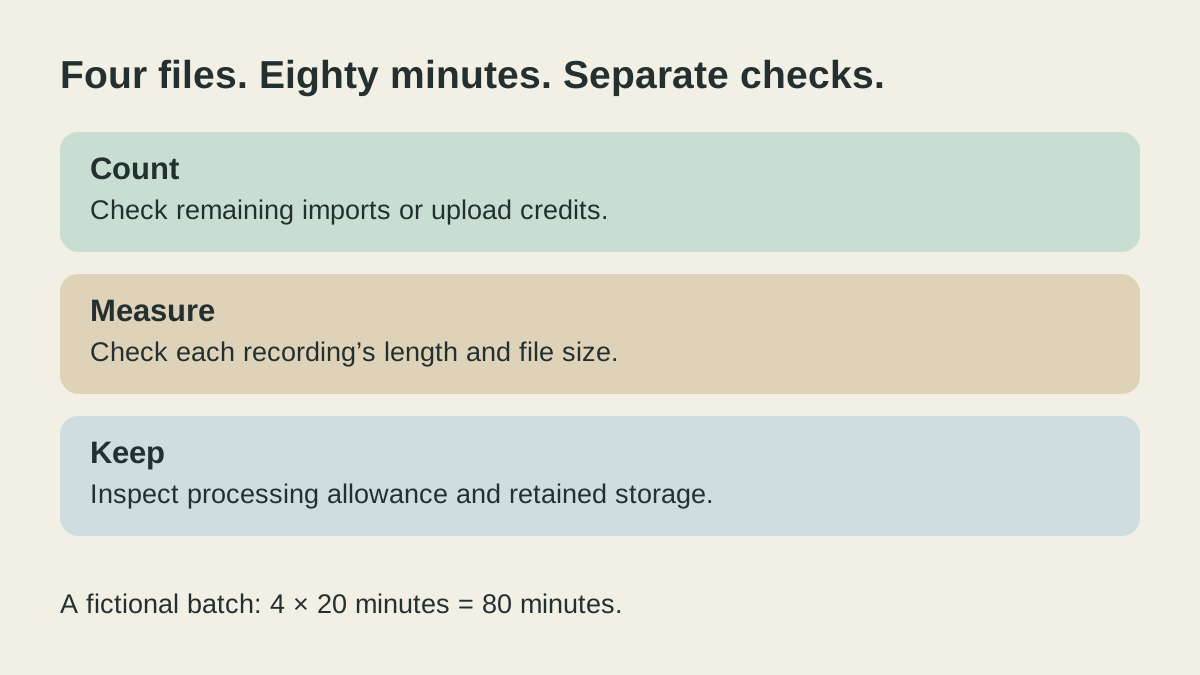
Imagine four authorized speech recordings, each 20 minutes long. This is a fictional example: four times 20 equals 80 minutes. That total is below Otter Basic’s documented monthly allowance, but four new imports exceed its three-import lifetime allowance even if none has previously been used. Counting only minutes would miss the limiting requirement.
| Batch check | What the fictional owner must establish |
|---|---|
| Number of files | How many lifetime imports or upload credits remain. |
| Individual length | Every file fits the applicable duration limit. |
| Total processing | The remaining processing allowance covers the planned work. |
| Retained material | The account has the required stored capacity and acceptable access. |
| Reviewed result | Names, figures and decisions match the original recording. |
For Fireflies, the same owner must establish the applicable credit balance and available stored minutes before deciding that the batch fits. This example does not claim that any new Free account can process four files. Compare the offer that covers the actual inventory; avoid choosing a paid plan solely because a headline says unlimited.
Evaluate Otter Basic for a small, occasional batch only when the remaining lifetime imports, monthly minutes and individual duration all fit. Evaluate Fireflies for existing files when its current upload credits, file requirements and available storage fit. If the account cannot cover the batch, compare the actual paid offer or another file-based route before uploading customer material.
Review the result before reusing a cover note
Listen back to the parts that matter and check names, amounts, dates and decisions against the original recording. A generated summary is a proposed account of the conversation, not an approved instruction to a customer. Decide who may receive the result and verify the intended destination before sharing it.
If introducing a reviewed result is a recurring phone task, Copied can be evaluated for manually reusing a neutral cover note and the current approved link in compatible iPhone or iPad drafts. Copied is not claimed to record, transcribe, check accuracy, produce meeting summaries or connect to Otter or Fireflies. Keep the individual recording and business decisions outside a generic reusable sentence.
The iPhone file-reuse guide covers the separate receiving-app handoff; the saved-link guide covers maintaining the destination. If introducing the result is a one-off task, review the individual message without adding another text library.
References
- Otter.ai, Pricing Basic lists 300 monthly transcription minutes, 30 minutes per conversation and three lifetime file imports. No numerical purchase prices; monthly minutes do not reset the lifetime import count. Reviewed October 30, 2026.
- Otter Help Center, Conversation, import, and app limits on the Basic free plan Basic remains available with limits: three imports per account rather than per month, 30 minutes of transcript access per recording and the 25 most recent conversations. Help updated December 5, 2023; current plan table corroborates selected limits. No paid-plan claim. Reviewed October 30, 2026.
- Fireflies Knowledge Base, What’s included in the Fireflies Free plan Signup credits vary by platform; uploaded recordings use credits. The eligible live-meeting auto-join offer is separate. Exact update date unavailable. No unlimited uploaded-file claim. Reviewed October 30, 2026.
- Fireflies Knowledge Base, Learn about transcription credits A Free uploaded file uses one transcription credit. The guide states a September 1, 2026 account boundary, with some older accounts retaining earlier limits. Current account balance and terms remain untested. Transcription credits and AI credits are separate. Reviewed October 30, 2026.
- Fireflies Knowledge Base, Understanding storage limits Free storage is 400 minutes per user, a total cap rather than a monthly allowance; team capacity is pooled. No deletion instructions, export entitlement or retention assurance. Reviewed October 30, 2026.
- Fireflies Knowledge Base, How to Upload and Transcribe Audio or Video Files in Fireflies Existing-file uploads support MP3, M4A and WAV audio with a 150-minute individual duration cap. Verify the actual account’s file-size allowance; conflicting generic size shorthand is omitted. No hands-on upload, accuracy or speed claim. Reviewed October 30, 2026.
- Copied, Copied product overview Manual reviewed cover-note and current-link reuse in compatible iPhone or iPad drafts. No recording, transcription, summary generation, Otter/Fireflies integration or automatic sending. Reviewed October 30, 2026.